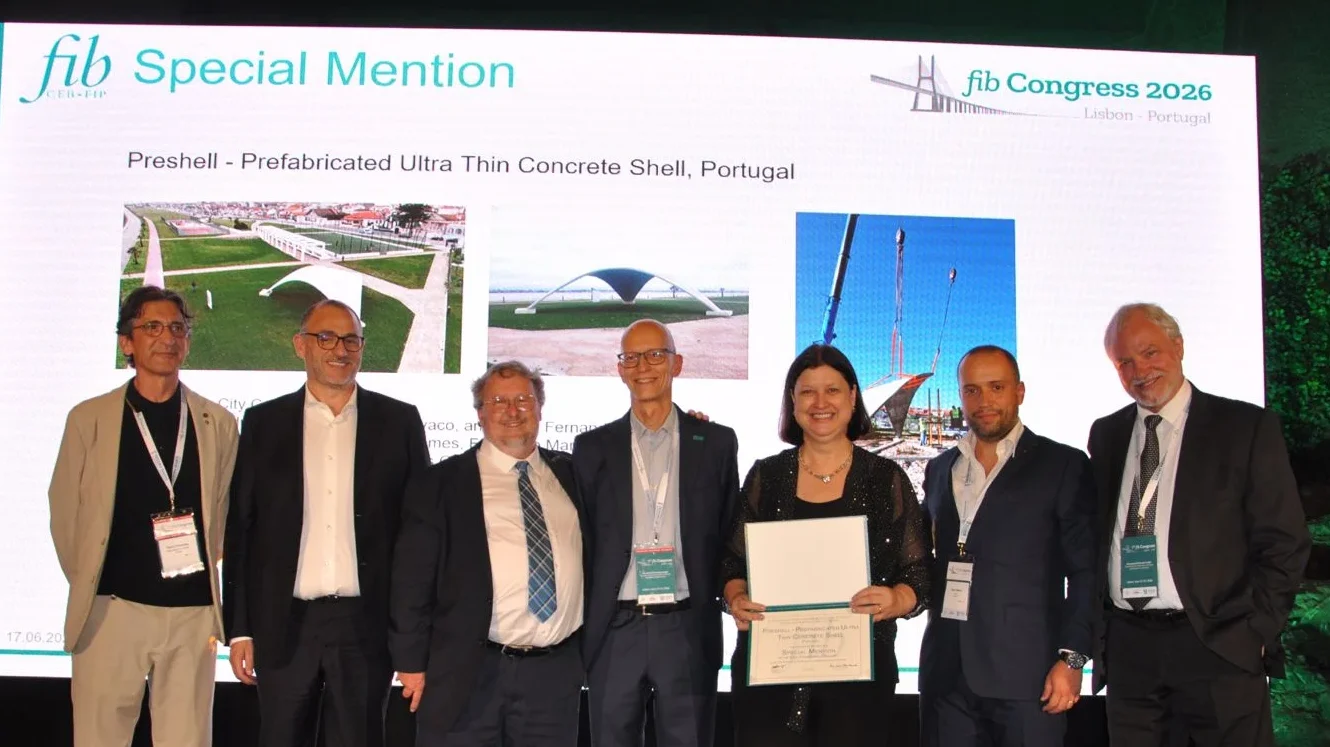
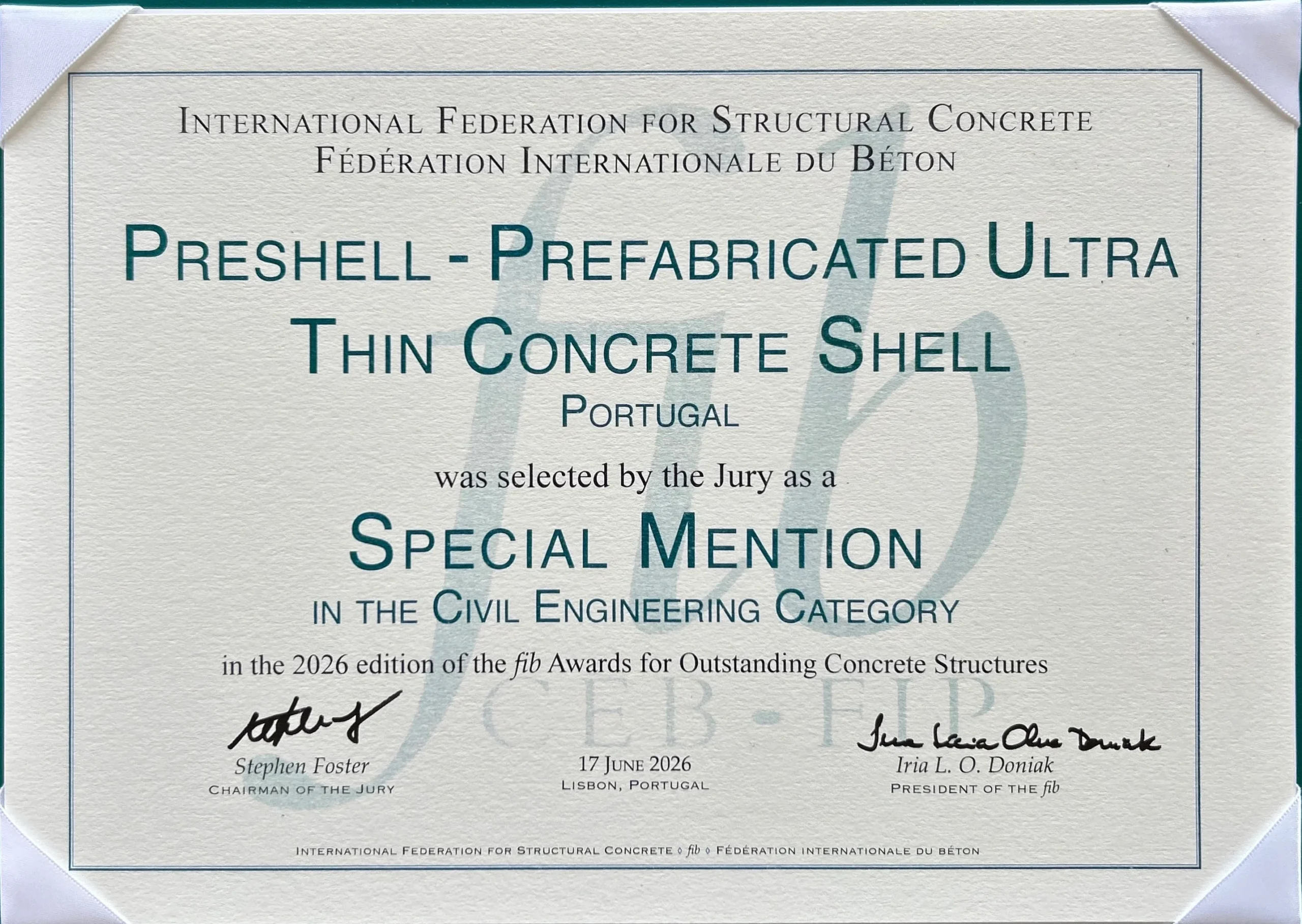
The Pre-Shell project, led by Professor Eduardo Júlio, researcher at CERIS and full professor at the Instituto Superior Técnico of the University of Lisbon (IST-UL), has been awarded a Special Mention in the prestigious fib Awards for Outstanding Structures 2026, one of the most significant international distinctions in the field of concrete structures.
The ceremony took place on 17 June 2026 during the gala dinner of the 7th fib Congress – Lisbon 2026, which brought together in the Portuguese capital structural engineering specialists, researchers and professionals from around the world. The awards, presented by the International Federation for Structural Concrete (fib), recognise structures that exemplify the versatility, innovation, and technical excellence of concrete as a structural material, across the categories of buildings and civil engineering structures.
Established within the framework of fib international congresses – held only every four years, continuing a tradition inherited from the former Fédération Internationale de la Précontrainte (FIP) – the Awards for Outstanding Structures are among the highest forms of international recognition in structural engineering. Over the past four decades, they have been awarded in cities such as New Delhi, Hamburg, Washington D.C., Amsterdam, Osaka, Naples, Mumbai, Melbourne, and Oslo, with Lisbon hosting the 2026 edition.
The distinction awarded recognises the prototype constructed in Ílhavo under the Pre-Shell project, a research and development programme funded by the National Innovation Agency (ANI). The project brought together a multidisciplinary team of researchers from IST-UL, FCT NOVA, ESTG-IPL, ISEC-IPC, LNEC, and FCTUC, in close collaboration with SPRAL – Sociedade de Pré-Esforçados de Aveiro, Lda.
Although developed in an applied research context, the project attracted the attention of the international jury due to its high level of technological innovation and its potential to transform construction methods associated with thin-shell concrete structures.
According to Professor Eduardo Júlio, the project originated in 2014 during a collaboration with Professor Isaías Vizotto of the State University of Campinas (UNICAMP), Brazil. Reflection on the gradual disappearance of shell structures, recognised for their structural efficiency and architectural and aesthetic quality, led to the identification of high labour costs as the main limiting factor in their contemporary use.
From this observation, an industrialisation strategy was developed based on a three-support shell inspired by the work of Swiss engineer Heinz Isler. The project incorporated advances across multiple scientific and technological areas: the generation of structural form through geometrically and materially non-linear analysis; the modularisation of the structure for prefabrication; the development of ultra-high-performance fibre-reinforced concrete elements, eliminating the need for conventional reinforcement; the creation of an assembly system based on unbonded single-strand prestressing tendons; and the experimental and numerical validation of structural behaviour under wind, seismic, and other design actions.
The system’s performance was further assessed through wind tunnel testing and shaking table testing at LNEC, complemented by advanced finite element models, with particular focus on prestressing effects and the behaviour of modular connections.
“The result of this outstanding collaborative work is the Ílhavo prototype. This international recognition from fib confirms the scientific, technological, and construction relevance of the developed solution,” says Eduardo Júlio.
The Special Mention awarded to Pre-Shell reinforces the position of Portuguese research at the forefront of international structural engineering and highlights the ability to connect academia, research centres, and industry in creating innovative solutions for the challenges of future construction.