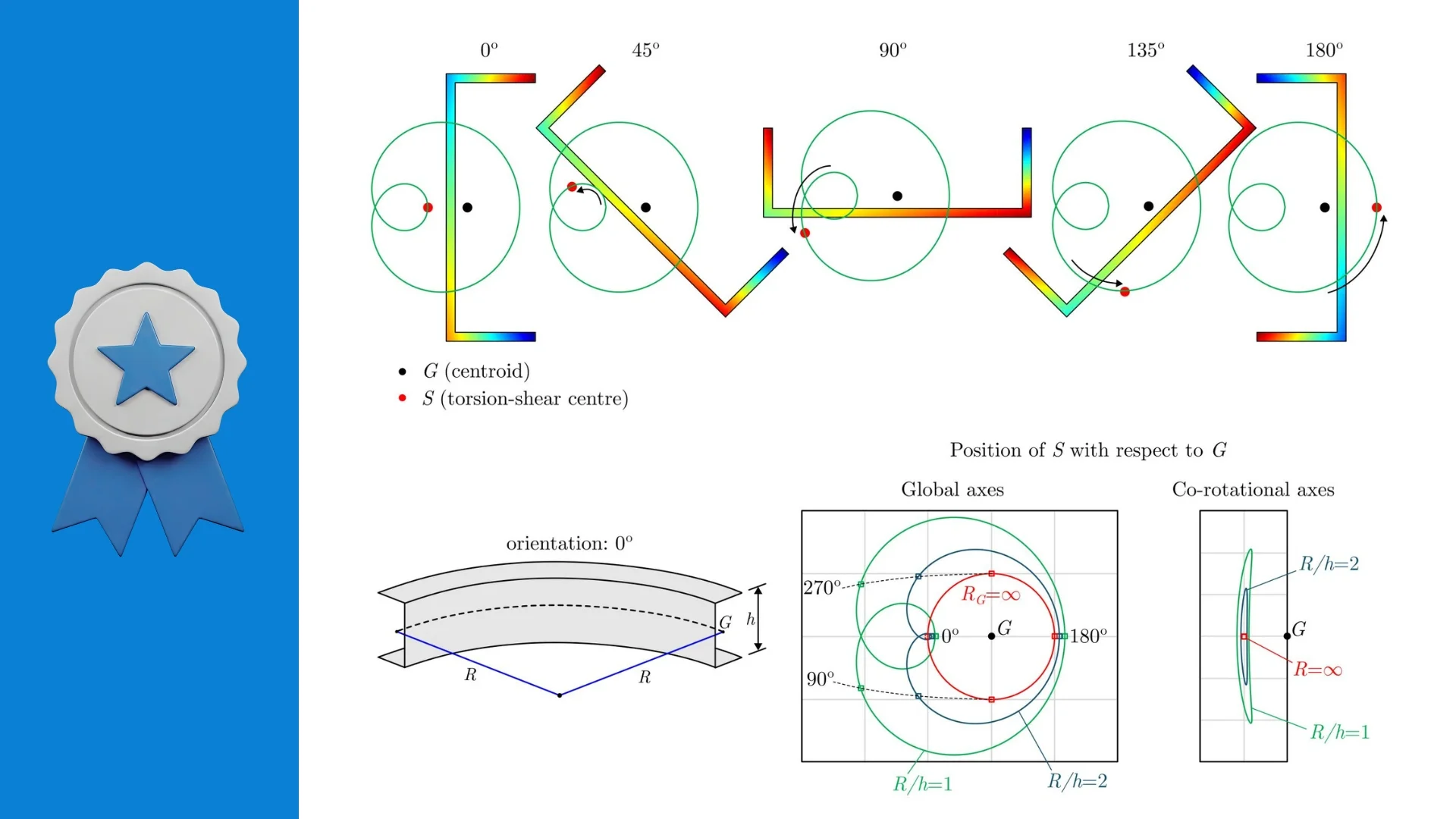
The work “Torsion-warping in highly curved beams” was awarded first place in the international Art & Science Competition, organised as part of CMN2026 – Congress on Numerical Methods in Engineering, held in Gijón, Spain.
The winning work was developed through a collaboration between Pedro Jacinto, PhD student in Civil Engineering at NOVA FCT, Rodrigo Gonçalves, Professor and researcher at the Department of Civil Engineering at NOVA FCT and member of CERIS, and Manuel Ritto Corrêa, Professor at Instituto Superior Técnico, Universidade de Lisboa.
The Art & Science Competition, integrated into the CMN2026 programme, brought together scientific research and artistic expression, inviting participants to present scientific concepts and research results through visually compelling works. The competition provided an opportunity to communicate complex scientific phenomena in an accessible and creative way, highlighting the relationship between scientific research, visualisation and artistic interpretation.
The winning work, “Torsion-warping in highly curved beams”, explores the structural behaviour of highly curved beams subjected to torsion, providing a visual representation of a complex phenomenon in structural mechanics.
The research highlights the complexity of the structural response of curved beams, particularly the relationship between the warping function, the position of the torsion-shear centre, the curvature of the beam and the orientation of its cross-section.
By transforming a complex numerical and structural mechanics problem into a visually engaging representation, the work demonstrates how scientific visualisation can contribute to communicating advanced research and making complex engineering phenomena more accessible.
The recognition at CMN2026 represents an important achievement for the team and highlights the value of interdisciplinary approaches to communicating scientific research.
Congratulations to Pedro Jacinto, Rodrigo Gonçalves and Manuel Ritto Corrêa on this achievement and on successfully bringing together science, engineering and art in an innovative way.